By: Prachi Gor
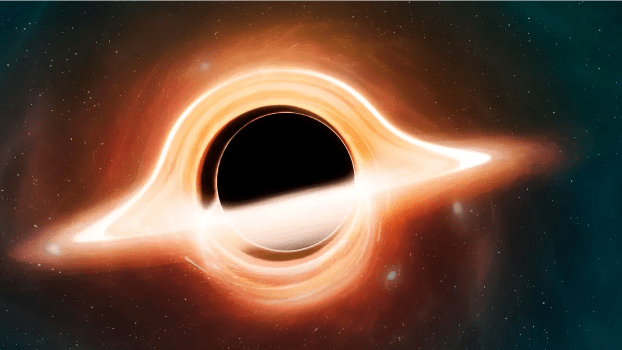
Black holes, one of the most unexplainable and fascinating occurrences in the universe, have captivated scientists for years. These altering areas of space contain gravity so extreme, that nothing—not even light—can be exposed, but what do we really know about these mysterious voids?
Well, black holes are typically difficult to study as they are in fact invisible. The mass in these intense voids is concentrated in a tiny region surrounded by a boundary called the “event horizon” (Doeleman). Astronomers typically generalize black holes into three different categories according to their masses: stellar-mass, supermassive, and intermediate-mass. There is also a fourth type suspected by cosmologists called primordial black holes. These black holes are thought to be lurking undetected in the cosmos after being formed during the birth of the universe.
Imagine a star with more than eight times the mass of our Sun running out of fuel. The core of the star would collapse, rebound, and burst into a supernova. Based on how large the mass of the star was, it could leave behind a super-dense neutron star the size of a city. If the prior mass of the star was over twenty times the mass of our Sun, it would collapse into a stellar-mass black hole. Stellar-mass black holes can carry on gaining mass by colliding with other stars and black holes. From observations formed by astrologists, almost all stellar-mass black holes have been discovered since they are paired with stars. It is believed that there is a high chance they originated as “mismatched stars”. This means that the massive star would have quickly evolved into a black hole. An occurrence called X-ray binaries may also happen, this is when the black hole has gas pulled off of the star and into a disk. This disk then excesses in heat to produce X-rays. Binaries are greatly helpful as they have revealed an estimated amount of fifty stellar-mass black holes just in the Milky Way. Scientists still suspect that there may be as many as one hundred million of these black holes in our galaxy by itself.
In the center of almost every massive galaxy, including our Milky Way, there is a supermassive black hole. These monstrous voids contain hundreds of thousands to billions of times our Sun’s mass. Sagittarius A* (pronounced ey-star), is the supermassive black hole in the center of the Milky Way. This black hole is four million times the mass of our Sun, considered relatively miniscule when compared to those discovered in other galaxies such as the black hole found at the center of Holmberg 15A which contains a minimum of forty billion solar masses. Astrologists are still unsure about how these massive voids came to be. Studying observations of distant galaxies proves that certain supermassive black holes were formed in the first billion years after the birth of the universe. According to NASA, “It’s possible these black holes began with the collapse of supermassive stars in the early universe, which gave them a head start.” Even though the origins of these areas of space are mysterious, it is known that supermassive black holes grow by taking over smaller objects, such as stellar-mass black holes and neutron stars, and how they also merge with other supermassive black holes when galaxies collide.
Astrologists believe that there must be a continuum of sizes of black holes and are bewildered by the size gap between stellar-mass and supermassive black holes. Over cosmic time, collisions with multiple stellar mass black holes should have produced intermediate-mass black holes. NASA explains how these voids should have a range from an estimated amount of one hundred to hundreds of thousands of times the Sun’s mass, or even tens of thousands. These products are all depending on how supermassive black holes are defined. Scientists are still on the active hunt to discover examples of these so-called missing-link black holes. Multiple potential examples have been identified but have been difficult to confirm.
Cosmologists theorize that primordial black holes were created in the first second of the birth of the universe. At that specific moment, pockets of extremely hot materials were possibly dense enough to create black holes. These areas of abyss might have ranged from one hundred thousand times less than a paperclip all the way to one hundred thousand more than our Sun’s. Cosmologists believe that these conditions for producing black holes this way ended as the universe quickly cooled down while expanding. Now, billions of years later, scientists still have not discovered definitive proof that these primordial black holes ever existed. However, it is possible that they might have evaporated while the cosmos aged due to quantum mechanical processes happening near the edges of all of their event horizons. Theoretical predictions actually proclaim that lower-mass black holes could evaporate sooner than the larger ones. These lower-mass black holes contain less mass than a mountain. This prediction explains how many of these early black holes have completely been used up. Other ginormous primordial black holes may still be straggling across the universe.
From the supermassive black holes harboring galaxies to the stellar-mass black holes created from collapsing stars, these massive mysterious voids have a crucial role in molding the structure and progress of the universe. Black hole formations and groupings can be intense, but exploring their influence on space and time has continuously helped with the ongoing pursuit to unlock the secrets of the cosmos.




 Scribemen Magazine