By Matthew Polyak
In 2006, United States Marine Lance Corporal Matthew Snyder was killed in action in Iraq. His father, Albert Snyder, decided to hold a funeral for his deceased son. Prior to the funeral proceedings, Fred Phelps and his followers at the Westboro Baptist Church of Topeka, Kansas, decided to protest the funeral, displaying signage that was deemed offensive by many, including Albert Snyder. After numerous lawsuits and trials, the case eventually met the Supreme Court. It’s ruling still affects us today, which is why I will go into depth about the case itself and its eventual societal importance.
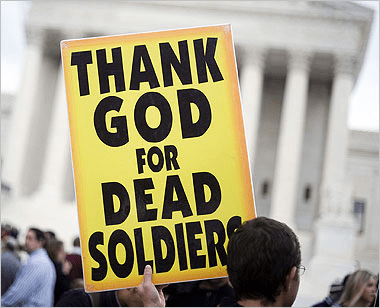
To continue, Snyder had driven past the protest, but was unable to recall what the protestors were saying until he returned home, where he discovered all of the information after watching a news broadcast. The signage displayed numerous messages, with some saying the following: “God Hates the USA… Thank God for 9/11… Thank God for Dead Soldiers]… You’re Going to Hell…” and more of what some deemed as ‘deplorable’ language.
This protest lasted for nearly half an hour. After the Snyders had learned what really happened, Albert Snyder filed a diversity action lawsuit against Phelps, his daughters (who were participants), and the church Westboro as a whole. His diversity action alleged that there was intentional infliction of emotional distress, intrusion upon seclusion, and civil conspiracy.
After a trial, a jury held Westboro liable for approx. $5 million in damages (compensatory and punitive damages). However, unhappy with the decision, Westboro challenged the verdict as ‘grossly excessive’ and sought judgment as a matter of law on the ground that the First Amendment fully protected its speech. Eventually, the Fourth Circuit Court of Appeals reversed the judgment, holding that Phelps’ speech was in fact protected by the First Amendment.
On December 23rd, 2009, Albert Snyder officially filed a petition for a writ of certiorari, with the petition being granted by the Supreme Court on March 8th, 2010. Then on October 6th, 2010, the Supreme Court officially began their deliberation on the case. The essential question for this case would be: “Does the First Amendment protect protesters at a funeral from liability for intentionally inflicting emotional distress on the family of the ‘deceased?”
After months of deliberation, the Supreme Court released the ruling on March 2nd, 2011. In an 8-1 landslide decision, the court affirmed the decision of the Fourth Circuit Court of Appeals, largely on its determination that the church was speaking on “matters of public concern” as opposed to “matters of purely private significance.” This meant that Phelps and Westboro would not be liable for the accused damages towards the Snyders. The Snyders would also then ultimately end up responsible not only for their own legal costs, but also for those of the organization they had been suing.
Of course, any case that has been decided by the Supreme Court would have large importance and implications. However, the specific case of Snyder v. Phelps stands out. This case specifically sets a legal precedent that individuals cannot recover for the tort of emotional distress based on picketing at military funerals because First Amendment protections shield this type of speech, meaning that those who find themselves in a similar predicament either could a) be unable to sue or b) be unable to further their case and receive their wanted remedy for the damages. While not remotely being the first case where homosexuality was involved, it was one of the first in the 21st century.
It also was another case that backed up First Amendment rights, and was historically important because of its establishment that speech made in a public place concerning public matters is protected by the First Amendment, regardless of whether it is offensive, outrageous, or causes emotional harm.
The political importance of Snyder v. Phelps ties in quite closely with the legal and historical importance of this case. Since it is a Supreme Court decision, lawmakers can not make “outrageous speech” used in a public setting that is used as concern for a public issue illegal/criminally punishable. It is a protected right under the First Amendment, and politicians nor lawmakers can do anything about that.
While there have been ramifications politically, legally, and historically, as mentioned above, there have also been ramifications which everyday citizens take to opinion [something popularly known as the “public court of opinion]. Many feel outraged because they feel that the use of the protestors language and the style of speech was immoral.
However, the legal system in this country has a clear split between legality and morality. This type of case specifically shows the separation, and while we as a whole may not like that, we must accept that. This country has speech protected.
Hate speech also is a huge issue that divides many, with some debating on where the line could be drawn. A decision such as this one essentially means that hate speech that doesn’t threaten others would be allowed.
The case of Snyder v. Phelps shows us that in law, we must look at an issue from its legality, not its morality. We also can not persecute others for their speech regardless of whether we like it or not. And that is a precedent that we will always follow in the United States, so long as this case remains precedent, which is up to future determination by none other than the 9 justices on the Supreme Court.
Sources
- SupremeCourt.gov
- CaseBriefs.com
- drexel.edu
- FirstAmendment.MTSU.edu
- supreme.Justia.com
- confluence.Gallatin.NYU.edu
- oyez.org
- SCOTUSBlog.com
- USCourts.gov



 Scribemen Magazine