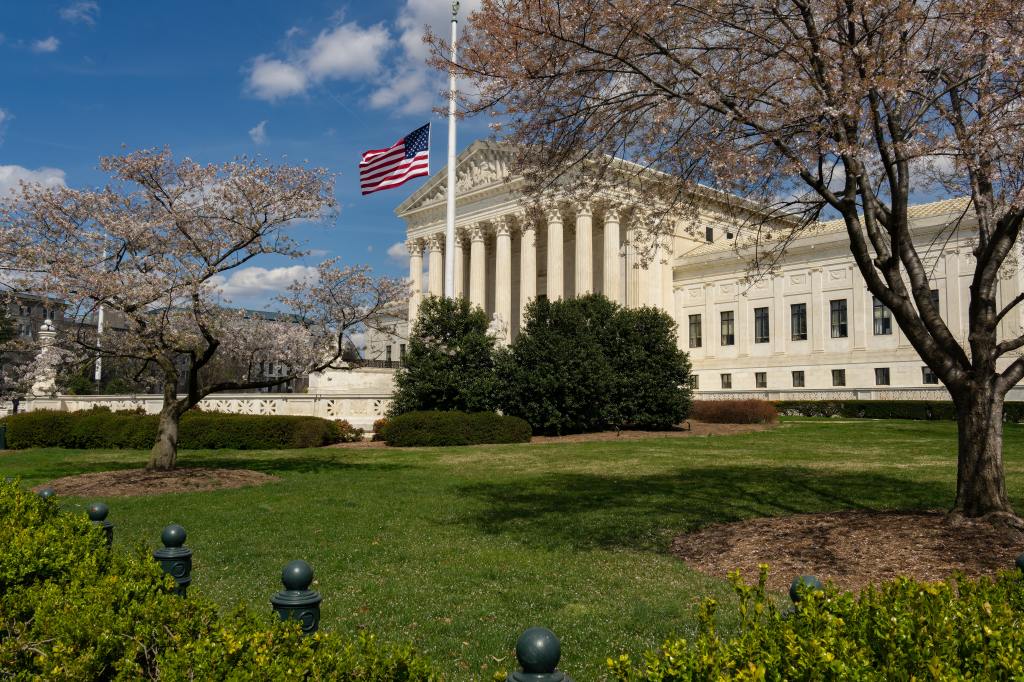
On the 29th of June, 2023, the Supreme Court of the United States issued a landmark ruling on Affirmative Action at colleges and universities in the United States. Affirmative Action is a set of policies that are aimed to increase educational and or workplace opportunities for people who are “underrepresented” in society. It focuses on demographics with historically low representation in leadership and professional roles. It is an attempt to eliminate discrimination. But through it’s use, it has become what it tried to stop.
Race-based Affirmative Action was the major issue of the case Grutter v. Bollinger, which the Supreme Court in a 5-4 decision decided that the University of Michigan Law School’s use of racial preferences in student admissions did not in fact violate the 14th Amendment, which has an Equal Protection Clause in it. The court had also decided that it did not violate Title VI of the Civil Rights Act of 1964.
In the majority opinion, Justice Sandra Day O’Connor (alongside Justices John Paul Stevens, David Souter, Ruth Bader Ginsburg, and Stephen Breyer) wrote “in the context of its individualized inquiry into the possible diversity contributions of all applicants, the Law School’s race-conscious admissions program does not unduly harm nonminority applicants.” The court had reasoned that since the specific Law School in this case conducts very
thorough and individualized reviews of each applicants, anyone who is accepted or rejected would not have been mainly for their race. This they also argued would make schools a more diverse environment.
However in recent years, the decision has become more criticized. In major schools, many Asian, Indian, and White Americans are at a clear disadvantage when applying for colleges. People started calling for the Supreme Court to re-look at this issue and to judge the constitutionality of the original ruling of Grutter v. Bollinger.
The disparities were most visible in applicants who applied for Harvard. Below is a chart showing the percent chance of one to be admitted to Harvard, provided by the American Enterprise Institute with the Academic Decile being a combination of test scores and GPA.
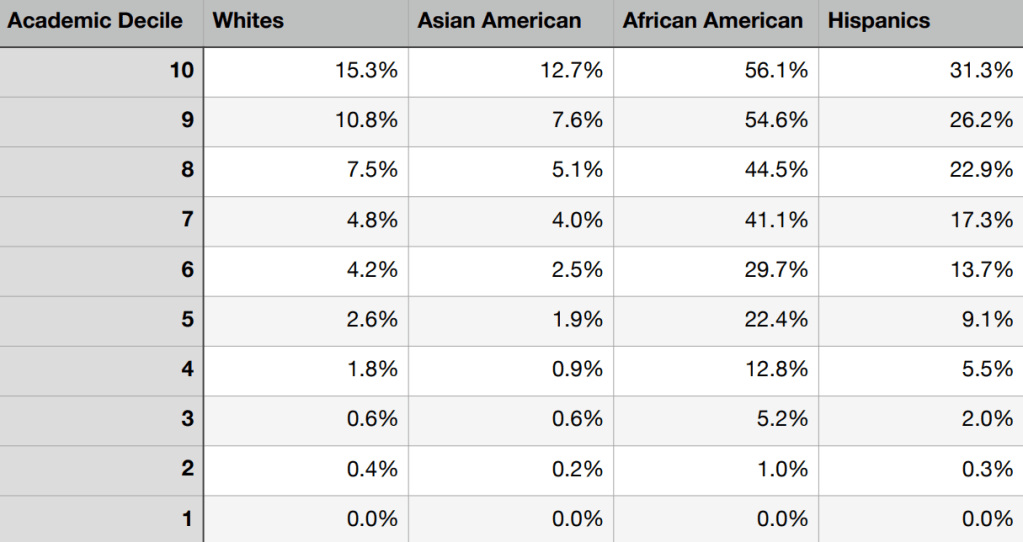
As visible above, an African American in the 5th academic decile, for example, would have a 20.5% more chance of getting into Harvard than an Asian American in the same academic decile. I believe that this, obviously, is absolutely discriminatory. Why should someone who worked as hard, or maybe even harder than someone else be denied solely on their race? I believe that the Supreme Court in their ruling of Grutter v. Bollinger were mistaken in their argument that anyone who is accepted or rejected would not have been mainly for their race.
A new case appeared in October of last year. A lawsuit between the Students for Fair Admissions and the President & Fellows of Harvard College, where SFFA argued that Harvard and the University of North Carolina’s admissions programs violated the 14th amendments Equal Protection Clause.
The Supreme Court looked through this case and issued a decision on June 29th, 2023 (as mentioned in the beginning). In a 6-3 decision, Chief Justice Roberts delivered a majority opinion with Justice Clarence Thomas issuing a concurring opinion and a response to a dissenting opinion from Justice Ketanji Brown Jackson. This decision essentially overturns and nulls Grutter v. Bollinger.
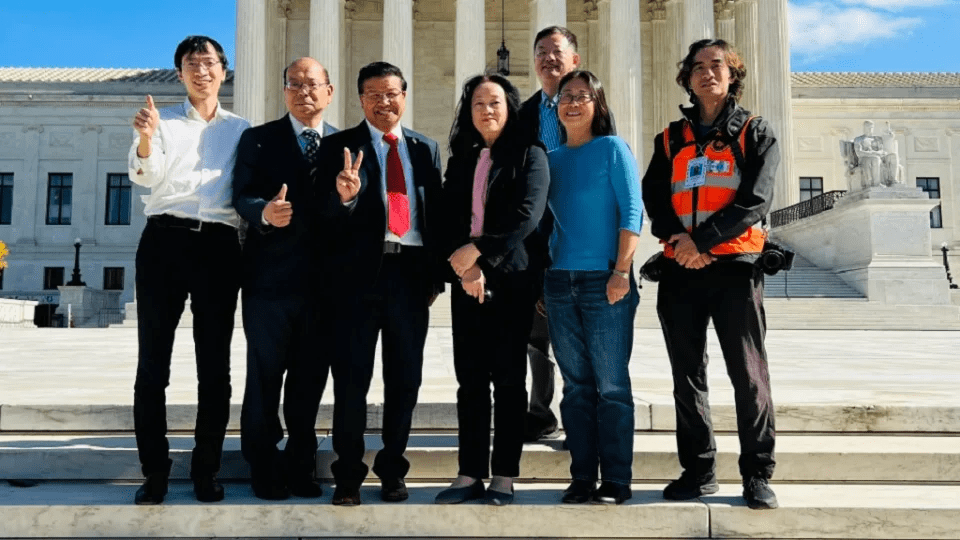
(PHOTO CREDITS: Yiatin Chu)
Like I mentioned earlier, I believe that this is a great thing, and that it is a step in the right direction. Hopefully, all affirmative action will be abolished soon, so people can have actual equal opportunities. In this country, we should be selecting people based on their qualifications (and those who are the highest qualified) and not based on their financial status, sex, race, religion, or sexual orientation. And for a little bit of irony, the people that you will see who are the most angry about this decision, are often, those who were hired due to affirmative action!
By Matthew Polyak



 Scribemen Magazine