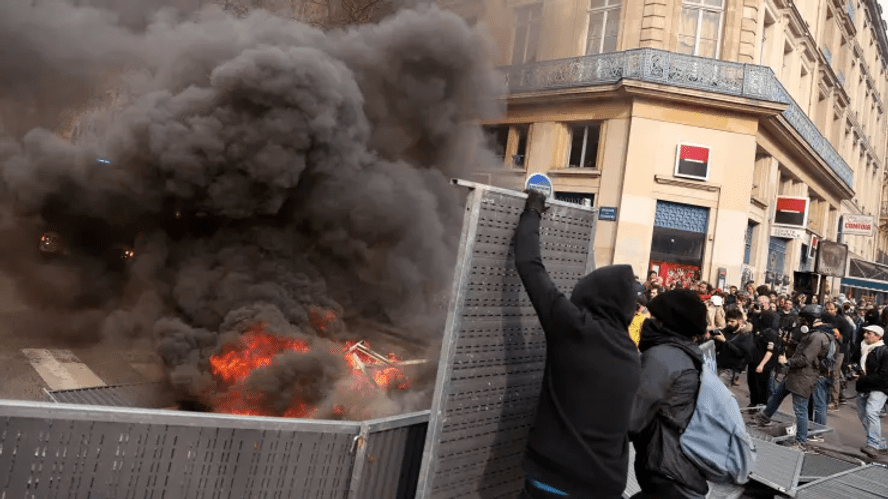
There have been mass protests occurring in France. This is because of President Macron’s potential policy of raising the retirement age in France from 62 years to 64 years. France currently has one of the lowest retirement ages in all of Europe, placing with nearby countries such as Greece, Italy, and Slovenia. Retirement has been a huge issue in France; and for many French, the ability to retire early would mean more financial aid for themselves and their families.
The protests in Paris began on May 1st, 2023, traditionally a day meant for union-led marches. Anger over the pension system policy implemented by the Macron administration persuaded many French people to incite violence across Paris. One of the biggest impacts of this was a building that caught fire at the Place de la Nation as the battle ensued between the protestors and the riot police. Approximately 112 thousand people participated in the protests, which is the second-highest turnout since the protests began earlier in the year. Tear gas filled the air, while protesters showed no sign of stopping or backing down. Police began to charge the protesters with water cannons and were met with barrages of fireworks and stones. By the end of the protests, more than 100 policemen ended up with severe burns.
Even though this was not enough to stop the French government from putting away the policy, French unions have reported that they would not stop fighting. And indeed they didn’t. Just a month later, in early June of this year, protesters took to the streets once again and marched on the headquarters of the Paris Olympics and began to slow traffic down at Paris’s Orly Airport. This new protest was designed to reignite the discontent the French people felt toward the policy. Due to the actions of this new protest, flights were canceled all around Orly Airport and 10 percent of trains located around France were disrupted. Activists pushed their way through the Paris Olympics headquarters and yelled out anti-Macron slogans, and many groups began to engage in small acts of vandalism.
So with all this trouble, commotion, and violence, what is the point of the protests? For the French people, it is not about the age of retirement. It is the balance between their work and life. Dating back to the late 20th century, pension reform has been a huge issue in France. For many in France, the pensions system is seen as the foundation of state responsibility and relationship with the citizens. The fact that those who are elderly or may come from lower-income households may need to work longer only ends up hurting those people financially. The personal component of the pensions system makes it seem like a relationship between the government and its people—and that is why the French have felt a strong rage towards Macron: they feel that he is disrupting that connection and availability.
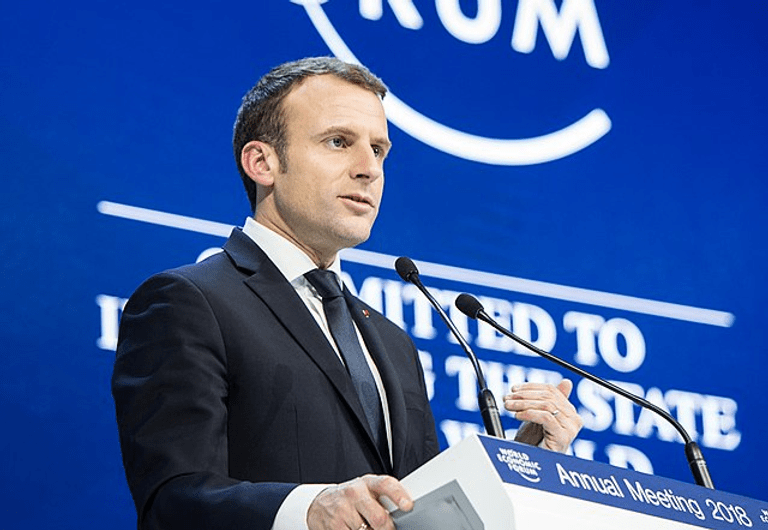
But what about Macron’s perspective? Why is his administration pushing to increase the retirement age? And what is the actual impact of doing this? For starters, Macron is a business-minded president. Central to his overall goal and mission is to make France a more firm-friendly environment and make the government a more efficient entity. Money is one of the driving factors in Macron’s considering this reform. The current system set in place, where the working population pays for the retirees’ social security, is simply not working; or, at the least, it is not as efficient as it used to be. On the plus side though, current state pensions are more generous than any other country. The country has one of the highest spending programs for state pensions than many other countries. In Macron’s vision, increasing the retirement age will allow France to grow more economically and give it the financial output it needs to grow.
So where does this lead? With regular incremental increases to wait time on pensions, by 2030 it is expected for France to reach its retirement age of 64. Even with this final decision, protesters are not wavering—with many saying that they will fight till the policy is abandoned. Having been re-elected in 2022, Macron still has four years left to serve France. This gives him the fixed-term power of the presidency, essentially meaning that his current position is safe. With the passage of these reforms, his administration has promised additional funding and programs for those who need financial support.
More environmental action from the President’s side has also been relayed in hopes of gaining back public approval. But with this policy, it seems that trying to win back the public could be out of reach for Macron. While the unions have led the protests, politicians and other political allies have come out to show support for the protesters and demonstrations. In my opinion, the damage has already been done by the Macron administration. Sending out new policies will not be able to fix what has already been lost. This could pave the way for other candidates to gain traction and popularity and could lead to a surprising outcome in the next election. All we can do now is to wait and see what truly happens.
By Krish Saraf




 Scribemen Magazine